
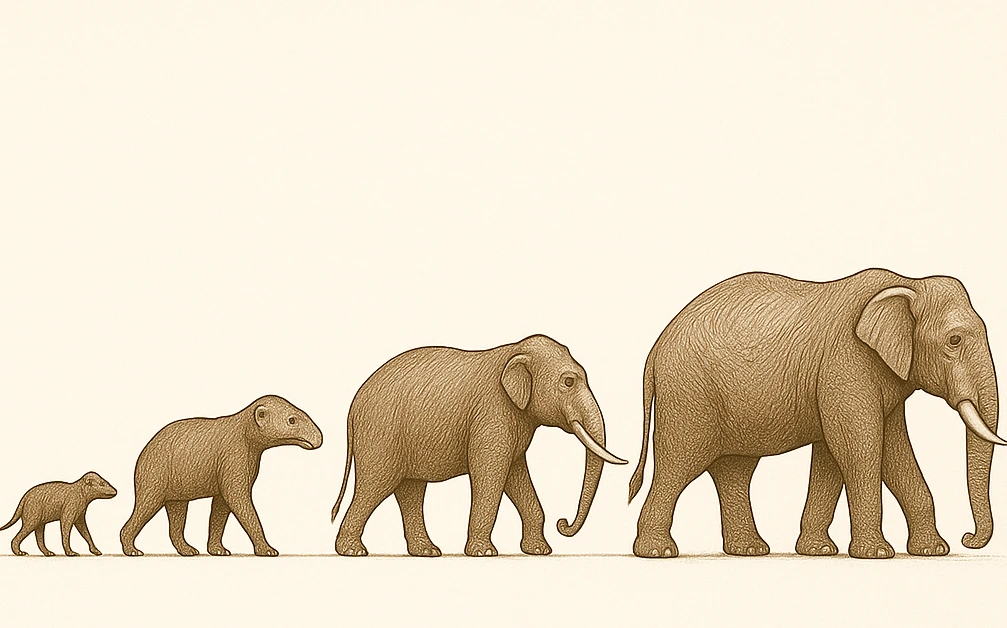
When we gaze upon elephants—whether the majestic wild ones or the gentle domesticated companions living close to humans—we might forget that the creature before us is the result of a journey spanning tens of millions of years. Modern elephants are the culmination of a process called evolution: the gradual transformation of living beings, generation after generation, developing new forms, functions, and behaviors that best suit their environment.
The Origins: From Water-Dwellers to Land Giants
The earliest ancestors of elephants didn’t roam the vast savannahs as we know them today. Instead, these creatures lived close to water, with a body shape reminiscent of modern hippos—stocky and about the size of a large pig. This prehistoric animal, called Moeritherium, lived approximately 37 million years ago in Africa. Their appearance lacked the elongated trunk and prominent tusks we associate with elephants, but Moeritherium marked the beginning of the long evolutionary path that shaped today’s elephants.
Table: Moeritherium vs. Modern Elephantsc
| Feature | Moeritherium | Modern Elephants |
| Body Size | About the size of a large pig | Largest land mammal |
| Habitat | Near water | Grasslands/forests |
| Trunk | None | Long and strong |
| Tusks | Elongated front teeth | Long, distinct tusks |
Teeth Tell the Story: The Evolution of Tusks
One of the critical clues paleontologists use to trace elephant evolution is the structure of their teeth. The front teeth of early elephants gradually lengthened, eventually evolving into the tusks we recognize today. Species such as Phiomia and Palaeomastodon (around 30–25 million years ago) began to develop short trunks and lengthened front teeth resembling tusks. These evolving features enabled elephants to adapt to both aquatic and terrestrial environments, providing advantages in feeding and self-defense.
Spreading Out: From Africa to the World
Around 20 million years ago, a new elephant ancestor, Gomphotherium, began to migrate from Africa into Europe, Asia, and North America. This genus sported four tusks (two upper, two lower) and marked an era of diversification into many lineages, including:
- Mammuthus (Mammoth): Adapted to cold climates, covered in thick fur, with long, curved tusks, and massive stature.
- Stegodon: Prehistoric Asian elephants, with fossils discovered in present-day Thailand.
- Elephas and Loxodonta: Direct ancestors of today’s Asian and African elephants, respectively.
The Mammoth: An Ice Age Legend and Extinction
The woolly mammoth (Mammuthus primigenius) stands as a symbol of adaptation during the Ice Age—large, shaggy, and equipped with long, curved tusks. Flourishing across frigid steppes for thousands of years, mammoths were eventually confronted by new threats: as the Ice Age ended, the climate warmed, food became scarce, and early humans increased their hunting. These pressures led to the mammoth’s extinction around 4,000 years ago.
Modern Elephants: The Last Survivors
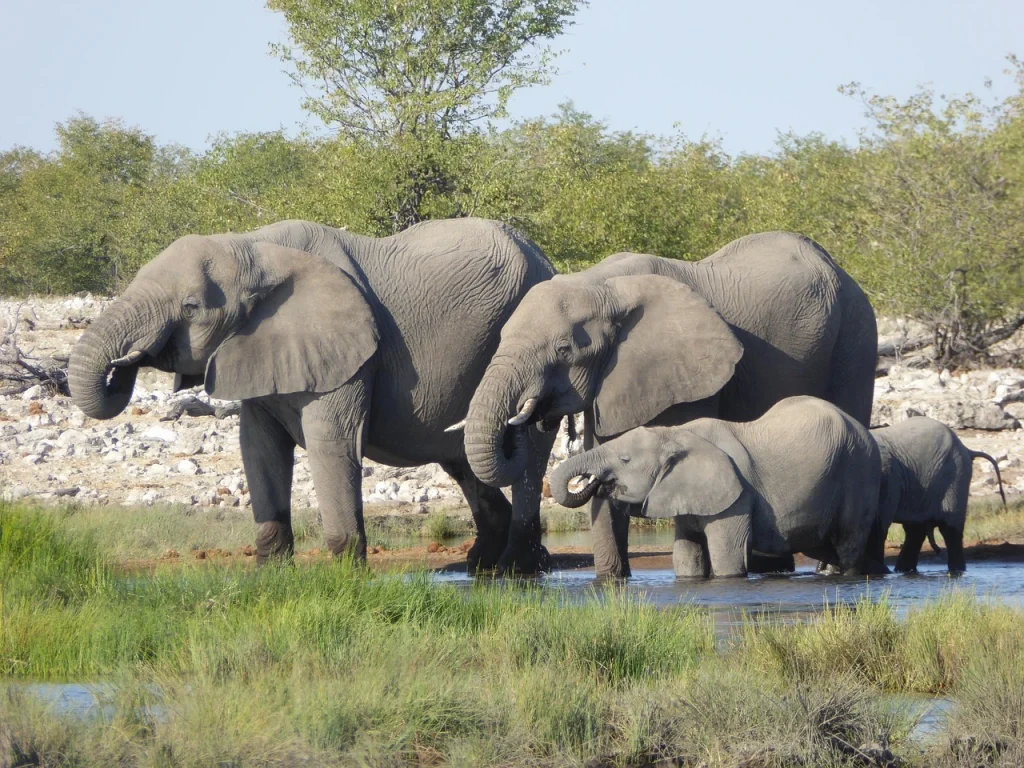
Today, only three species of elephants remain:
- African Bush Elephant (Loxodonta africana): The largest land animal on Earth, notable for its large ears and long tusks in both males and females.
- African Forest Elephant (Loxodonta cyclotis): Smaller and more secretive, dwelling in dense West and Central African forests, with slender, downward-pointing tusks.
- Asian Elephant (Elephas maximus): Found in South and Southeast Asia, with smaller ears, tusks usually only in males, and a closer relationship with humans.Throughout their evolutionary journey, elephants have continually adapted—from body shape to dental structure—allowing them to survive the world’s changing environments and fierce competition.
Elephants and Chiang Mai Culture: More Than Just Wild Animals
In regions like Chiang Mai, formerly the heart of the Lanna Kingdom, elephants are far more than beasts of burden. Here, they are woven into the fabric of culture and belief:
- Historically, elephants played major roles in logging, warfare, and royal ceremonies.
- The fabled white elephant is seen as a symbol of power and auspiciousness.
- Traditional rituals such as the “Pook Kwan Chang” ceremony are intended to bless and protect the well-being of elephants.
Even today, elephants inspire local art, literature, and spiritual objects, reflecting their ongoing significance in northern Thailand’s way of life.
The Future of Elephants: Humanity Holds the Key
Despite surviving the severe tests of evolution, elephants’ fate now depends more on humans than nature. They face new dangers:
- Habitat loss due to deforestation and land development
- Poaching for tusks and other body parts
- Exploitation as labor or entertainment, often under harsh conditions
Yet, there is hope. Many organizations and sanctuaries—such as Le Cher Elephant Home in Chiang Mai—are devoted to the protection and ethical treatment of elephants, striving to give these giants the freedom and dignity they deserve.
Lessons from Elephant Evolution
The story of the elephant is a powerful reminder: “In a changing world, only those who adapt will survive.” These magnificent creatures have adjusted to shifting climates, environments, and even human expansion. Today, humanity bears the responsibility for their continued survival.
Compassion, conservation, and a true understanding of the elephant’s value are not just tasks for experts or locals—they are the shared duty of humankind. Together, we can ensure that these gentle giants continue to roam the earth for generations to come.
References
- The Evolution of Elephants, Smithsonian National Museum of Natural History
- BBC Earth, “How the Elephant got its Trunk”
- National Geographic, “Woolly Mammoth”
Visit, Learn, and Make a Difference
Be part of the journey that protects and honors these incredible creatures. At Le Cher Elephant Home, a trusted elephant sanctuary in Chiang Mai, we provide a safe, ethical environment for elephants to thrive — free from harm and full of care.
- Come walk with giants.
- Support real conservation.
- Experience the spirit of Chiang Mai through the eyes of an elephant.
Book your visit today or learn more about our ethical elephant experiences at https://lecherelephanthome.com/ .

Pingback: Local Mahouts at Our Elephant Sanctuary in Chiang Mai
Pingback: Chiang Mai & Elephants: A Shared History
Pingback: Elephant Sanctuary Chiang Mai: Why It’s the Perfect Location
Pingback: Why Baby Elephants Eat Dung | Elephant Sanctuary Chiang Mai
Pingback: Elephant Herbal Medicine – Ethical Sanctuary in Chiang Mai
Pingback: Elderly Elephant Care – Ethical Elephant Sanctuary Chiang Mai
Pingback: Managing Stressed Elephants at Chiang Mai Ethical Sanctuary
Pingback: Caring for Calves – Elephant Sanctuary Chiang Mai
Pingback: Explore Ethical Elephant Sanctuary Chiang Mai with Your Family
Pingback: Ethical Elephant Sanctuary Chiang Mai | Le Cher Elephant Home
Pingback: Best Time to Visit an Ethical Elephant Sanctuary Chiang Mai
Pingback: Elephants and Nature | Ethical Elephant Sanctuary Chiang Mai
Pingback: Elephant Behavior – Chiang Mai Sanctuary
Pingback: Le Cher: Elephant Sanctuary Chiang Mai Nature experience
Pingback: Ethical Elephant Sanctuaries in Chiang Mai | Le Cher
Pingback: Walk with Elephants: Chiang Mai | Le Cher Elephant Home
Pingback: Family Elephant Sanctuary Chiang Mai | Le Cher Elephant Home
Pingback: Yi Peng Festival Chiang Mai with Le Cher Elephant Home
Pingback: Karen People and Elephants | Le Cher Elephant Home
Pingback: Stay Overnight with Elephants in Chiang Mai | Le Cher Elephant Home
Pingback: Homestay with Elephants at an Ethical Sanctuary in Chiang Mai
Pingback: Family Half Day Elephant Sanctuary Chiang Mai | Le Cher
Pingback: Chiang Mai Travel: Doi Suthep & Ethical Elephant Experience
Pingback: Ethical Elephant Care in Chiang Mai | Visit Le Cher Elephant Home
Pingback: Elephant Home Chiang Mai | Le Cher – Family-Run Ethical Elephant Home
Pingback: Elephant Sanctuary Thailand | Le Cher Elephant Home
Pingback: Elephant Park Chiang Mai | Small Group Experience